Philanthropy as a Wealth Tool: capital that cannot be inherited, only nurtured
Money is passed down through wills. Values are passed down only through example.
This seems to be the main thing people miss when discussing wealth transfer between generations: you can specify every share and condition in a trust, but you cannot “specify” in a document that an heir will feel responsible for what they’ve received. That can only be learned one way: by watching parents make decisions, and gradually starting to make them together.
And this isn’t about isolated cases. According to the UBS Global Family Office Report 2026, adult heirs in many families still barely participate in decisions about capital. At the same time, ultra-wealthy individuals account for roughly $59.8 trillion in wealth worldwide, and 36% of private charitable giving comes from this group.
This creates a curious paradox: families are willing to pass down capital, but not always willing to pass down the right to make decisions about it.
That’s why many see philanthropy not as charity in the conventional sense, but as one way to prepare the next generation for the responsibility of capital.
Here, philanthropy isn’t a line in a family sustainability report. It’s a chance to give the next generation their first experience managing resources, before they have to make decisions about the family’s capital as a whole.
For many wealthy families, philanthropy has long been not just a way to help others, but a way to raise heirs. That’s how the Rockefellers, the Rothschilds, and the Gates family approach it.
The Rockefellers: philanthropy as part of upbringing
The Rockefeller story didn’t begin with a foundation. It began with a family habit. John D. Rockefeller’s mother taught her children to give away part of any income to charity, and over time this became part of the family culture.
When his son, John D. Rockefeller Jr., became interested in public service, his father didn’t just support him financially. He entrusted him with real responsibility, appointing him chairman of the Rockefeller Foundation.
Later, this approach evolved into a system. In 1967, the Rockefeller brothers created the Rockefeller Family Fund, where younger family members could learn to make decisions through grant-making and charitable projects.
Today, seventh-generation family members are already involved in this work: more than 150 descendants of John D. Rockefeller.
And what holds this system together isn’t so much documents as family principles: regular communication across generations, a long-term view on decisions, and an understanding that philanthropy is just as much a responsibility as managing capital.
The Rothschilds: what unites the generations
Today the Rothschilds have hundreds of descendants living in different countries around the world. A shared business uniting the whole family no longer exists.
But there is something that remains common across generations: philanthropy.
Jacob Rothschild spoke of it as one of the few elements that continues to bind the large family together. Not through assets or companies, but through shared values and an understanding of the responsibility that comes with privilege and opportunity.
Interestingly, the Rothschilds never handed down a ready-made list of projects for descendants to support.
What was passed from generation to generation was a different principle: each era faces its own challenges, and philanthropy should respond to exactly those.
So the forms change, but the values remain.
The Gates family: interest matters more than obligation
Bill and Melinda Gates’s approach to their children is often described in one phrase: exposure, not compulsion.
The idea for the future foundation didn’t come from a desire to create yet another charitable organization. It all started with an article about child mortality that Bill Gates sent to his father, with a simple thought: “Maybe we can do something about this.”
That conversation sparked a discussion about the issues the family considered important.
Not from a sense of duty to engage in philanthropy, but from personal interest and a desire to understand.
That approach later became part of the family’s culture.
What these families have in common
The stories and families are different, but the approach is strikingly similar.
First, heirs are brought in early. Instead of promising that responsibility will fall on them someday, they’re given the chance to make decisions now.
Second, this isn’t a one-time effort. Philanthropy becomes part of family life through regular meetings, joint projects, and ongoing dialogue between generations.
And most importantly, what gets passed down isn’t specific projects or organizations.
What gets passed down is an approach.
Not “support exactly this,” but “here’s how we make decisions, and why we consider it important.”
That’s precisely why each new generation can choose its own direction while still preserving the family’s shared values.
Together Forever Foundation: an example from our own practice
For Wise Wolves, this isn’t abstract theory.
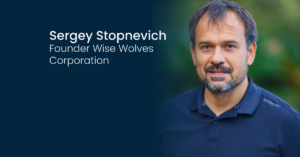
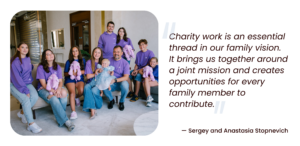
In 2016, the company’s founder, Sergey Stopnevich, established the Together Forever Foundation. Over the years, the foundation has become not a standalone charitable project but part of the Stopnevich family culture, with the children taking part in the foundation’s work.
Over time, these values became part of Wise Wolves’s corporate culture as well. So for us, philanthropy is a natural extension of the principles on which both the founder’s family and the company itself are built.
When a business and a foundation grow side by side over many years, employees, partners, and clients see not just the results of the company’s work, but the values behind those results.